![]()
Why Hospitals Should Fly
by John J. Nance, JD
The 2009 ACHE James A. Hamilton Book of the Year Award Winner
This book is a one-of-a-kind, eye-opening narrative chronicling the incredible transformational journey of St. Michael’s Memorial Hospital. John Nance created this hospital to give healthcare the benefit of an experimental "laboratory" where vision, ideas, dialogue, and action connect synergistically to illustrate what healthcare could, and ultimately must, do in order to realize the ultimate in patient safety and quality care.
Even though the characters and the hospital John Nance created are fictitious, the problems they face and the solutions they develop and adopt are all too real. It will only take one visit to Nance’s St. Michael’s to leave everyone in healthcare with an understanding of why no one has ever put all the pieces of the safety and quality puzzle together before.
Although many of the pieces have been known in healthcare circles for some time, vital elements of the solution have been missing…the picture incomplete. St. Michael’s incredible journey confirms that completing the picture requires implementing the bedrock-basic cultural and systemic principles that every high-risk institution must instill as their foundation of safety and quality. It is those very principles the aviation industry paid such a tragically bloody price to discover that prove to be the missing pieces and the new foundation of St. Michael’s safety and quality renaissance.
This book is much more than merely a great story. In these pages John Nance has challenged healthcare with an intensely urgent call to action. He has provided a guide on how to break free of the destructive cultural foundations of the past, and a comprehensive education about the realities of what it will take to make America’s hospitals the safest and highest reliability organizations in the world.
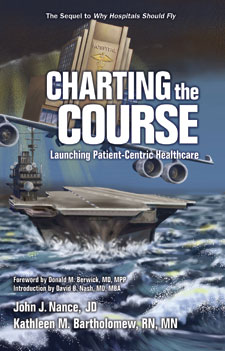
The Sequel, Charting the Course by John J, Nance, JD & Kathleen Bartholomew, RN, MN [ more ]